
|
|
Innocence Lost in times of confused ideologies |
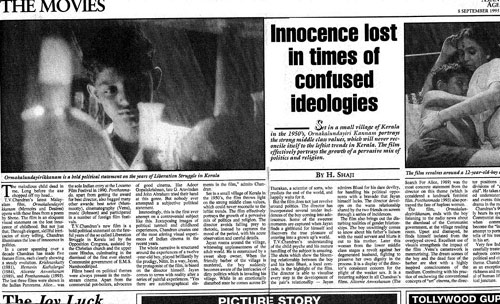 |
|
The melodious child dead in
me, Long before the axe chopped off my head
T. V.
Chandrans latest Malayalam film, Ormakalundayirikanam
(Memoirs and Desires) opens with these lines from a poem by Shene. The film is
an eloquent visual statement on the lost innocence of childhood. But not just
that. Through elegant, skillful intricacies of story telling, Chandran
illuminates the loss of innocence in politics. In a
career spanning over a decade Chandran has made five feature films, each
clearly showing a steady evolution. Krishnankutty
(1981), Hemavin Kathalrgal (1984), Alicinte
Anweshanam (1989), and Ponthanmada
(1993). The last three films were shown in the Indian Panorama. Alice was
the sole Indian entry at the Locarno Film Festival in 1990. Ponthanmada, apart
from getting the award for the best director, also bagged many other awards;
best actor (Mammootty), cinematography (Venu), music (Johnson), and
participated in a number of foreign film festivals. T. V.
Chandran s new film is a bold political statement on the fateful years of
the so called Liberation Struggle in Kerala led by the Opposition Congress,
assisted by the Christian church and the upper caste Hindus, culminating in
the dismissal of the first ever elected Communist government of E. M. S.
Namboodiripad. Films
based on political themes were always present in the mainstream cinema. Apart
from the commercial potboilers, advocates of good cinema, like Adoor
Gopalakrishnan, late G. Aravindan and John Abraham tried their hand at this
genre. But nobody ever attempted a subjective political statement. Interestingly,
this is the first ever attempt on a controversial subject like this.
Juxtaposing images of political turmoil and childhood experiences, Chandran
creates one of the most stirring visual experiences of Indian cinema in the
recent years. The whole
narrative is structured around the experiences of a twelve-year-old boy,
played brilliantly by the prodigy, Nitin. In a way, Jayan, the protagonist of
the film, is based on the director himself. Jayan comes to terms with reality
after a series of painful experiences. Yes, there are autobiographical
elements in the film, admits Chandran. Set in a
small village of Kerala in the 1950s, the film throws light on the strong
middle class values, which could never reconcile to the leftist trends. The
film effectively portrays the growth of a pervasive mix of politics and
religion. The director avoids falling prey to rhetoric, instead he captures
the mood of the period, with his acute observation and careful details. Jayan
roams around the village, witnessing unpleasantness of the adult world. He is
entertained by a sweet shop owner. When the friendly barber of the village is
murdererd, the boy suddenly becomes aware of the intricacies of dirty
politics, which is invading his village. While in an emotionally disturbed
states he comes across Dr. Tharakan, a scientist of sorts, who predicts the
end of the world, and happily waits for it. But the
film does not just revolve around politics. The director has incorporated
several tender incidences of the boy coming into adolescence. Some of the
sweetest moments are captured when Jayan finds a girlfriend for himself and
discovers the true pleasure of entering into a grown up s world. T. V.
Chandran s understanding of the child psyche and his mature handling of the
subject is amazing. The shots, which show the blooming relationship between
the boy and his hero Bhasi, a local comrade, are the highlight of the film.
The director is able to visualize every step in the in the development of the
pair s relationship Jayan admires Bhasi for his dare devilry, for
handling his political opponents with a bravado that Jayan himself lacks. The
director develops on the warm relationship shared by the two friends on screen
through a series of incidences. The film
also brings out the disturbing realities of gender relationships. The boy
unwittingly comes to know about his father s liaison with the maid servant
and blurts it out to his mother. Later this woman from the lower middle class
stages a revolt against her degenerated husband, fighting to preserve her own
dignity in the process. It is a display of the director s consistent concern
for the plight of the weaker sex. It is a recurring subject in all
Chandran s films. Alicente Anweshanam
(The Search for Alice, 1989) was the most concrete statement from the director
on this theme (which is considered a landmark feminist film). Ponthanmada (1993) also portrayed the fate of hapless women. The film, Ormaklundayirikkanam,
ends with the boy listening to the radio news about the dismissal of the
Communist government, at the village reading room.
Upset and dismayed, he finds himself isolated from the overjoyed crowd.
Excellent use of visuals strengthens the impact of the film. Venu s
camerawork is mesmerizing. The dream scenes of the boy and the dead face of
the barber are shot with a highly inspired consciousness of the medium.
Continuing with his practice of eschewing the conventional concepts of
art cinema, the director positions himself above the divisions of
art and commercial . He takes recourse in calculated
understatements of emotions and events this is what builds the drama in the
movie. Chandran s
90-minute film clearly bears its sympathy towards the Communist movement. At a
time when communist-baiting has become the in thing, Chandran s
attempt to portray it on screen only tells his tremendous conviction in his
art. Very few
Indian films have successfully treated such controversial subjects correctly,
balancing the political and cinematic aspects of a theme. Chandran s films
stand out as an exception with its aesthetic richness and multi-layered
portrayal of human life at a certain historical juncture. The
Asian Age 8 September 1995 |
||
Last
updated/modified on April 17, 2001. 2000-2001 H Shaji. All rights reserved.
Contact
Me.