
|
|
Asserting an IdentityH. Shaji |
 |
|
|
The
turbulent times that Indian Muslims are passing through are, perhaps, the
worst since the Partition. An agonised Shabana Azmi was forced to admit,
“I’ve never had the word Muslim hurled at me before.” In this light, Magrib,
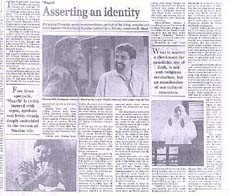
the directorial debut of Kerala filmmaker P. T. K. Muhammed, is a bold
assertion of the Muslim identity and a response to the communal challenge. Shunning
the staple diet of so-called ‘serious’ cinema, the calculated
understatement of emotions and expressions, Magrib,
instead depicts the living, complex, and multi-layered life of a
Valluvanadan (South Malabar) Muslim community in Kerala. Although
Kerala is known for a high degree of political awareness and religious
harmony (as compared to other States in India), the portrayal of Muslim life
in Malayalam films continues to be dominated by clichés. Despite
the fact that films focussing on Muslim subjects proved to be instant hits,
the Muslim characters presented in these films have, by and large, been
unreal and Muslim life has largely been appropriated merely as a decorative
frill. Besides
films like Umma (1960), Kandom
Becha Kottu (1961), Mailanchi
(1982), Maniyara (1983), and Manithali
(1984), a large number of films belong to the genre of popular ‘Muslim
films.’ In fact, such was the box office success of these films that some
directors came to exclusively handle films that focussed on Muslim subjects. Outside
such ‘Muslim films’, Muslim characters were relegated to the comedy
section or treated as mere props to hold up the ‘communal amity’ theme.
In the rare instances when they were featured as main characters, they were
turned into spectacles as in 1921,
a film by I. V. Sasi on the Malabar rebellion of 1921. It
was only the rare film that tried to rise above the conventional, formulaic
treatment of Muslim life in cinema. Pavithran’s Uppu
(1986) is one such example of a refreshingly bold attempt to delve deep
into the subtle details of the lives of Eranadan Muslims. But, Magrib,
shot with a more subtle self-assurance, surpasses Uppu’s
power and content. While
focussing on a rather neglected area of India’s heterogeneous social
fabric, Muhammed’s film paints an extraordinary portrait of a society
without the slightest hint of the sluggishness that is often the hallmark of
films which try to counter the prevalent aesthetics of popular cinema. Steeped
in the middle class milieu of a Muslim community of South Malabar, Magrib
asserts the existence of a middle class life among the Muslims. Fighting shy
of even the slightest communal undertones, Magrib
is an illustrious statement about ethnic identity within the framework of
secularism. This
unapologetic and beautiful visual ensemble, made by a director who is also
from South Malabar, transcends the philosophy that speaks for the supremacy
of the majority sections and inferiority of the minorities. The deeply disturbing fate of Razak (played brilliantly by Murali) is at the centre of the film’s plot. For years, Razak has been confined to a mental asylum because in a temporary fit of insanity, he killed his wife. However, the attending doctor pronounces Razak as completely cured since he has been off medication for the past three years. Magrib
opens with a visit to the asylum by Razak’s brothers who want to inform
him about the arrangements made for his daughter’s marriage. Razak’s
close friend Sreenivasan (also called Muhammadunni in the film) initiates
efforts to secure Razak’s release through a government order so that the
father can attend his daughter’s wedding. But
the release of Razak becomes a social issue with wider implications
encompassing Razak’s social status and family decency, among other things.
Because his return is perceived as a threat to society’s value system, all
those who were intimately connected with Razak finally surrender to this
reality and abandon their efforts to help him attend his daughter’s
wedding.
Muhammadunni,
however, is unwilling to give in. he tried to talk to Razak’s daughter,
Mumtaz, only to find that for her, Razak is nothing more than the killer of
her mother. Ultimately, Mumtaz’s marriage is conducted without the
presence of her father. Meanwhile,
an eager Razak prepares himself to come out of his forced isolation only to
find that nobody has come to receive him on the planned day. Thus, his dream
of returning to a normal life, like Magrib
(Dusk), plunges into the grim darkness of the night. Magrib
is richly layered with signs, symbols, and lively rituals deeply embedded in
the terrain of Muslim life. It is also free of the spectacular presentation
of their lives that one often sees in mainstream cinema. By simply
juxtaposing shots of how customs are done in different social and religious
groups, the films reveals the age-old co-mingling and cultural transactions
between the Hindu and Muslim communities. Another
striking feature of the film is the virtual absence of any kind of overtly
secularist postures. The recent attempts to resist the onslaught of
fundamentalism have resulted in a certain reductionist secularism that has
tended to equate almost anything religious with a fundamentalist purpose.
Instead of attempting to present any rational/modern alterative to a
religious society, Magrib adds to
its power by grounding itself in the specifications of our cultural context. The
search for a Muslim identity is a natural sequence to the social and
political demeaning that Muslim identity has had to face. In India from
Mahatma Gandhi onwards, many leaders have practised various methods to
maintain the harmony between the two major communities. The Partition and
related riots proved the inadequacy of the paternal secularism of Gandhi.
After independence, another type of secularism, say the Lucknow style,
emerged. By adopting Muslim-like dresses and listening to ghazals, this new
style of secularism tried to blend the two cultures. Nehru can be seen as
the best representative of this tradition. But that too proved futile. Old
clichés and old idioms are not sufficient to analyze new dilemmas.
Secularism is not something to be lectured on only through available
platforms and art forms. It is also not possible to promote it through films
like Amar Akbar Anthony. What is
needed to checkmate the monolithic use of faith, is not the ‘non‘ or
anti-religious secularism, but instead a useful examination of our cultural
resources, pertaining to rituals and customs. And Muhammed’s Magrib
is definitely a product of such a quest for identity. The Economic Times 29 January 1994
|
||
Last
updated/modified on April 17, 2001. ©2000-2001 H Shaji. All rights reserved.
Contact
Me.